Collaging a Digital Time Machine
Updated: Aug 18
"Marching Backwards into the Future"

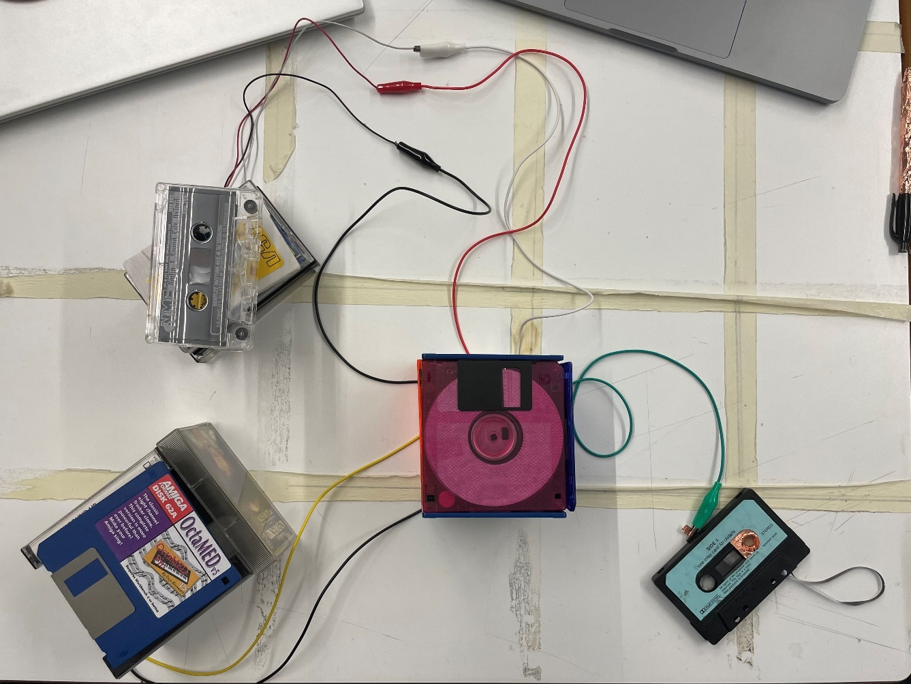
In my first class 'Sketching in Hardware and Software', I was tasked with developing an interactive experience using digital collage and the coding software 'Scratch'. I then had to present this digital collage on an arcade machine.
The context for the experience was a quote taken from Marshall McLuhan's book 'The Medium is the Massage: An Inventory of Effects':
"Marching Backwards into the future"
Marching backwards into the future is a concept presented by the philosopher Marshall McLuhan in which he describes how, as people, we tend to look to the past to help us shape our present. We can only understand things in the context of what we already know and, for example, when new media develops, we will try to use it with the narrowed viewpoint of its predecessor.
In ‘The Medium is the Massage’, McLuhan states that “the medium of our time is electric technology”. I decided to make this concept the main subject of the interaction. The digital collage features four kinds of technological devices: computers and word processors, data storage, music players and communication devices. The interaction begins by displaying older forms of each technology and the user can then press the machine’s buttons to cycle through the subsequent developments. I thought it would be interesting to see how much technology has changed over time through immediate comparisons, yet how resemblance can still be seen through the past models and their functionality.


I also wanted to explore the idea of obsolete media within the interaction. As we move steadfastly into the future with new, mass-produced technological inventions and innovations, we are quickly accumulating a significant amount of old and now obsolete media. The brand-new technology we are using today will be vastly different in a few decades and we can see this trend by looking back.
The project began with the more traditional form of collage. Paper. I collected news articles, magazines, wallpaper clipping and images and began arranging different compositions and subject matters. This was a quick and efficient way of forming ideas, understanding what worked and what didn't.


I chose to create a collage of newspapers to form the backdrop of the interaction, a medium that is slowly starting to decline. The articles feature adverts for new technology that nowadays would be considered obsolete. In contrast, others are reporting on the fading out of their own contemporary technology. I have also included images of electronic waste to illustrate what may be in store for some of our soon-to-be expired media. I took photographs of article clippings and then edited them on photoshop, layering them all together to create a collage.

The most challenging aspect of this project was getting to grips with the programming software Scratch. I had never tried coding before so was diving in with no prior experience. Luckily, Scratch and YouTube had many tutorials I was able to follow, and the program is very user friendly. I had to attach code to each element of the collage and then to a corresponding key (which would act as the arcade machine buttons) in order to bring it to life and turn the still image into an interactive experience. This process involved a lot of trial and error, however after sometime I was able to get it to function as I wanted.

While working on this project I also spent some time researching the theory behind designing interactive experiences. As presented in the 2008 paper by Zafer Bilda, Ernest Edmonds and Linda Candy, ‘Designing for Creative Engagement’, when people use interactive experiences, they encounter different phases: adaptation, anticipation, learning and deeper understanding. By pressing the buttons, a pattern can be recognised, and the user will come to learn and anticipate a response from the interaction as they gain control of the experience and understand its function. However, by introducing an unexpected element, this will force the user to alter their expectations and (hopefully) engage them further.
I attempted to create this element of surprise within my experience. If the user presses the red button a delay will trigger and after three seconds a collage of error messages will appear. During this time the other buttons will loose their function for ten seconds. This may initially surprise the user into thinking the technology has broken. As they wait, it will become apparent that this was deliberate, as a quote from Howard Tullman appears, asserting that the obsolescence of technology is to be expected.
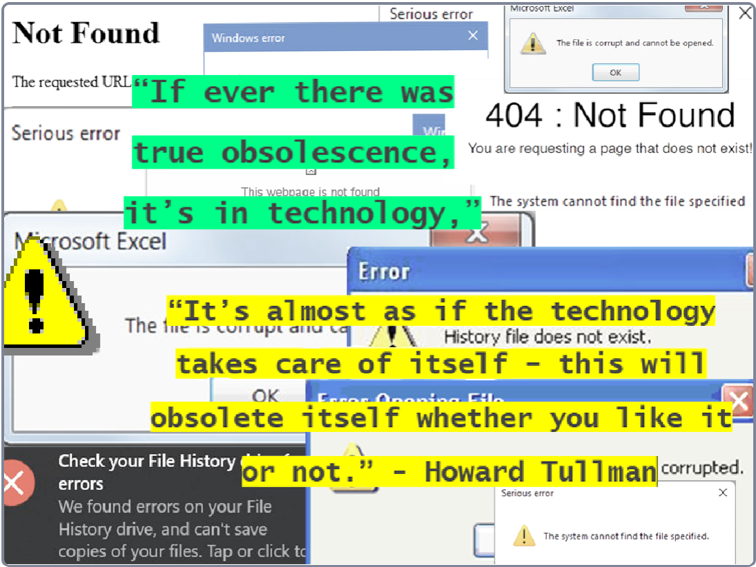
The creation of this interactive experience aimed to present the context of Marshall McLuhan's ‘Marching Backwards into the Future’ through my own interpreted understanding. I believe that in our age of electric technology, we are often taking inspiration from old, obsolete media to influence new products. But even with new advancements and state-of-the-art technology, we must remember that our old media and its messages can become lost if not preserved. The devices we depend on today will likely become obsolete in the years to come as this cycle repeats.

Comments